


Could Mailing FIT Kits Be the Key to Boosting Colorectal Cancer Screening in Adults Under 50?
Key Highlights
- Unsolicited mailed fecal immunochemical test (FIT) outreach achieved significantly higher screening rates than active choice strategies in adults aged 45 to 49 years.
- Overall screening participation was low, with only 18.6% completing screening within 6 months.
- Active choice requiring portal response reduced participation by approximately 9 to 12 percentage points compared with default mailed FIT outreach.
- Offering both FIT and colonoscopy modestly increased screening completion compared with offering a single option.
In a randomized clinical trial of more than 20,000 average-risk adults aged 45 to 49 years, default unsolicited mailing of a FIT kit was the most effective strategy to increase colorectal cancer screening. Only 18.6% of participants completed screening within 6 months, with markedly lower participation in all three active choice groups compared with the mailed FIT group. Active choice—requiring patients to log into the portal and select a screening option—resulted in substantially fewer completions. Offering both FIT and colonoscopy options modestly improved participation compared with offering a single modality, though the increase was small.
Colorectal cancer (CRC) incidence among adults younger than 50 years has risen nearly 15% over the past three decades, prompting the US Preventive Services Task Force in 2021 to lower the recommended screening age to 45 years. While outreach strategies such as mailed FIT kits have proven effective in older adults, there has been little evidence on how to engage newly eligible younger adults. Given low baseline screening participation in this population—only 1.51% within 20 months of the updated recommendations—this trial aimed to directly compare different outreach methods.
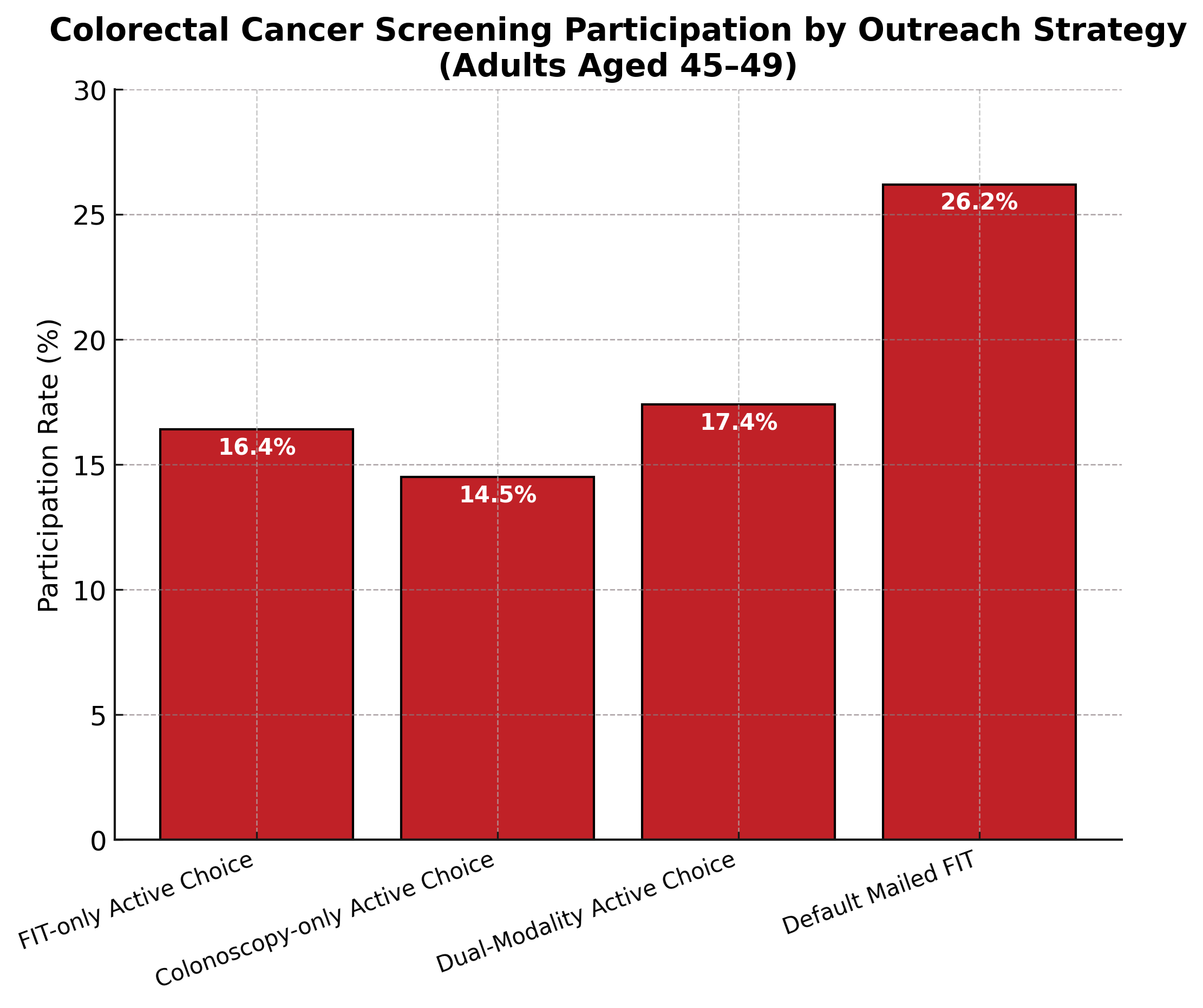
The study, conducted within UCLA Health, randomized 20,509 average-risk patients to one of four groups: FIT-only active choice, colonoscopy-only active choice, dual-modality active choice (FIT or colonoscopy), or usual care default mailed FIT outreach. All groups received electronic portal messages and text reminders, but only the default mailed FIT group automatically received a kit without needing to respond. The primary outcome was completion of any screening within 6 months, assessed via electronic health records.
Screening participation was highest in the default mailed FIT group at 26.2%, compared with 16.4% for FIT-only active choice, 14.5% for colonoscopy-only active choice, and 17.4% for dual-modality active choice (all P < .001). Within the dual-modality group, colonoscopy completion exceeded FIT completion (12.0% vs 5.6%). Crossover was notable: nearly 10% of participants assigned to FIT groups completed colonoscopy instead, whereas only 2.7% of the colonoscopy-only group opted for FIT. Among participants with abnormal FIT results, 73% completed follow-up colonoscopy within 6 months.
Limitations include the single-center design, restriction to average-risk individuals, and reliance on a health system with high portal engagement, which may limit generalizability. Some colonoscopies performed outside the health system were not captured, and the short follow-up may have favored FIT completion over colonoscopy.
“This study offers robust evidence for how to engage this age group in CRC screening,” Galoosian et al concluded. “Future research should explore further optimization and tailoring of mailed FIT outreach to enhance screening participation across diverse populations and in other health care settings.”
Reference:
Galoosian A, Dai H, Croymans D, et al. Population health colorectal cancer screening strategies in adults aged 45 to 49 years: a randomized clinical trial. JAMA. 2025:e2512049. doi:10.1001/jama.2025.12049