



Peer Reviewed
Young Man Who Passed a Worm

HISTORY
A 35-year-old man presents to your office with a worm (shown below) that he found in the toilet after a morning bowel movement. He denies any recent fever, chills, nausea, or vomiting.
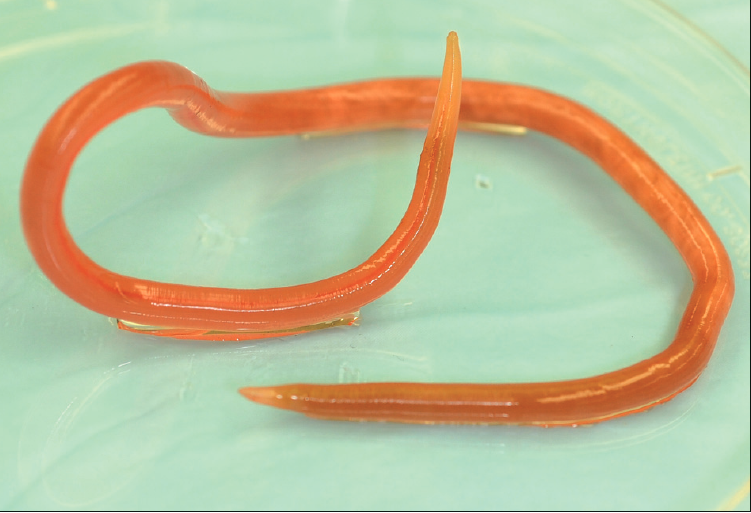
He is otherwise healthy and occasionally drinks alcohol. He does not take any daily medications and has no history of significant medical disorders. He works as an entertainer and recently returned from a several-month tour in Southeast Asia.
PHYSICAL EXAMINATION
His vital signs are stable, lung are clear, and heart rate and rhythm are regular. Abdominal examination reveals normal bowel sounds and no masses, guarding, or rebound. Rectal examination shows no excoriations or gross bleeding.
WHAT’S YOUR DIAGNOSIS?
Answer on next page.
1. Crompton DW. How much human helminthiasis is there in the world?. J Parasitol. 1999;85(3):397-403.
2. Luoba AI, Wenzel Geissler P, Estambale B, et al. Earth-eating and reinfection with intestinal helminths among pregnant and lactating women in western Kenya. Trop Med Int Health. 2005;10(3):220-227.
3. de Silva NR, Chan MS, Bundy DA. Morbidity and mortality due to ascariasis: re-estimation and sensitivity analysis of global numbers at risk. Trop Med Int Health.1997;2(6):519-528.
4. King CH, Fairley JK. Cestodes (tapeworms). In: Mandell GL, Bennett JE, Dolin R, eds. Principles and Practice of Infectious Diseases. 7th ed. Philadelphia, Pa: Elsevier Churchill Livingstone; 2009:chap 290.
5. Wang LC, Hwang KP, Chen ER. Enterobius vermicularis infection in schoolchildren: a large-scale survey 6 years after a population-based control. Epidemiol Infect.2010;138(1):28-36.