



Peer Reviewed
Firm Erythematous Nodules in a Term Newborn

Introduction. A late-term newborn, born at 41 weeks and 1 day gestation to a 31-year-old G5P4 mother, developed erythematous nodules on the right shoulder on day 2 of life during routine inpatient evaluation.
History. A female infant born late-term at 41 weeks and 1 day to a 31-year-old G5P4 mother with no classic maternal metabolic risk factors was delivered via cesarean section due to history of prior shoulder dystocia in a previous pregnancy, arrest of progressive cervical dilation, and intermittent category II fetal heart tracing. The pregnancy was uneventful with adequate prenatal care. The infant weighed 4225 g and was 53.5 cm in length. Her Apgar scores were 8 and 9 at 1 and 5 minutes, respectively. Her amniotic fluid was meconium-stained and duration of membrane rupture prior to delivery was 5.6 hours.
The first 24 hours of life were notable for 2 episodes of hypoglycemia at 44 mg/dL at 6 hours of life and 43 mg/dL at 9.5 hours of life, both of which resolved after administration of oral 40% glucose gel. These episodes were consistent with transient neonatal hypoglycemia and resolved prior to the onset of cutaneous findings. At 33 hours of life, the infant’s mother observed red skin lesions on the infant’s right arm. There was no history of trauma or cold exposure, and the parents denied irritability, feeding difficulties, lethargy, or similar skin findings in their other children.On physical examination, two firm, non-tender, erythematous to violaceous subcutaneous nodules measuring 2-3 cm were present over the lateral aspect of the right deltoid. The remainder of the examination was unremarkable, and the infant appeared well.
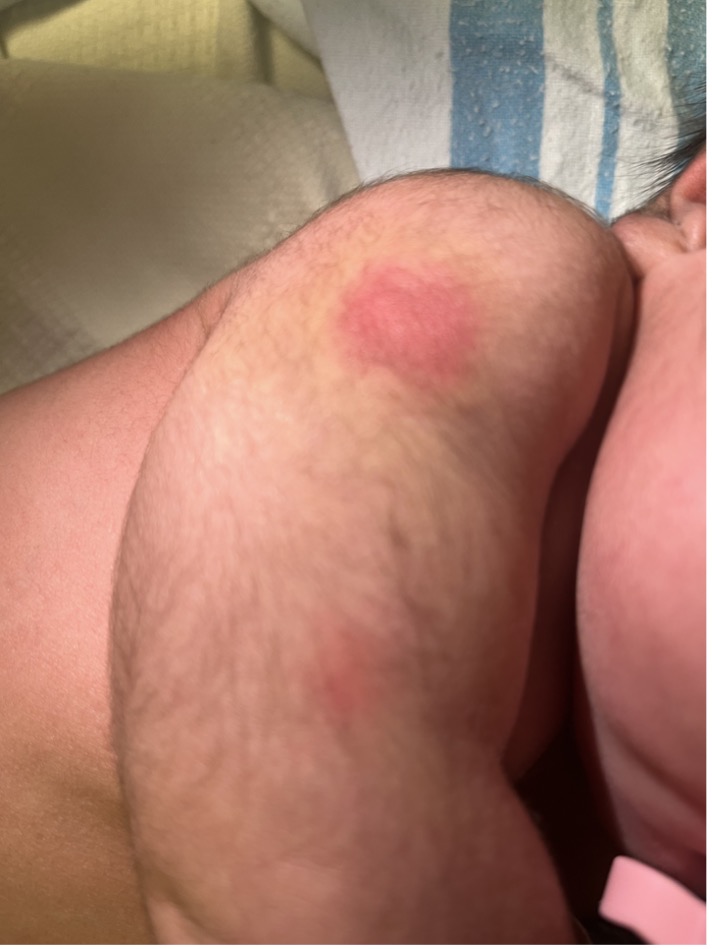
Figure 1. Two subcutaneous nodules were noted on the lateral right deltoidDiagnostic testing. Comprehensive metabolic panel (CMP) and complete blood count (CBC) with differential was within normal limits. The ionized calcium level was within normal limits (1.20 mmol/L) (Table 1).
Table 1. Laboratory results: CMP and CBCTest
Results
Reference Range*
Sodium, mmol/L
136
135–145
Potassium, mmol/L
4.8
3.5–5.5
Chloride, mmol/L
105
98–107
Bicarbonate, mmol/L
19
18–24
Calcium, mg/dL
9.4
8.5–10.5
Calcium (Ionized), mmol/L
1.20
1.10–1.35
Blood urea nitrogen, mg/dL
5
3–12
Glucose, mg/dL
67
45–90
Anion gap, mmol/L
12
8–16
Creatinine, mg/dL
0.51
0.3–1.0
Albumin, g/dL
3.5
3.0–4.5
Alkaline phosphatase, U/L
260
150–420
Alanine aminotransferase, U/L
33
5–45
Aspartate aminotransferase, U/L
58
20–140
Total bilirubin, mg/dL
3.2
<5 (age-dependent)
Total protein, g/dL
7.3
4.5–7.5
White blood cell count, ×10³/µL
17.4
9–30
Red blood cell count, ×10⁶/µL
5.73
4.0–6.0
Hemoglobin, g/dL
21.0
16–22
Hematocrit, %
61.6
48–68
Mean corpuscular volume, fL
107.5
95–120
Mean corpuscular hemoglobin, pg
36.7
30–37
Red cell distribution width, %
16.8
14–20
Platelet, ×10³/µL
302
150–400
*Reference ranges may vary by institution and postnatal age.