


Keeping the “Heart” in Heart Health: Cardiovascular Risk and Ultra-Processed Foods, Pt. 1
Key Highlights
- Higher consumption of ultra-processed foods is associated with increased risk of hypertension, cardiovascular disease, heart attack, and stroke across large and diverse populations.
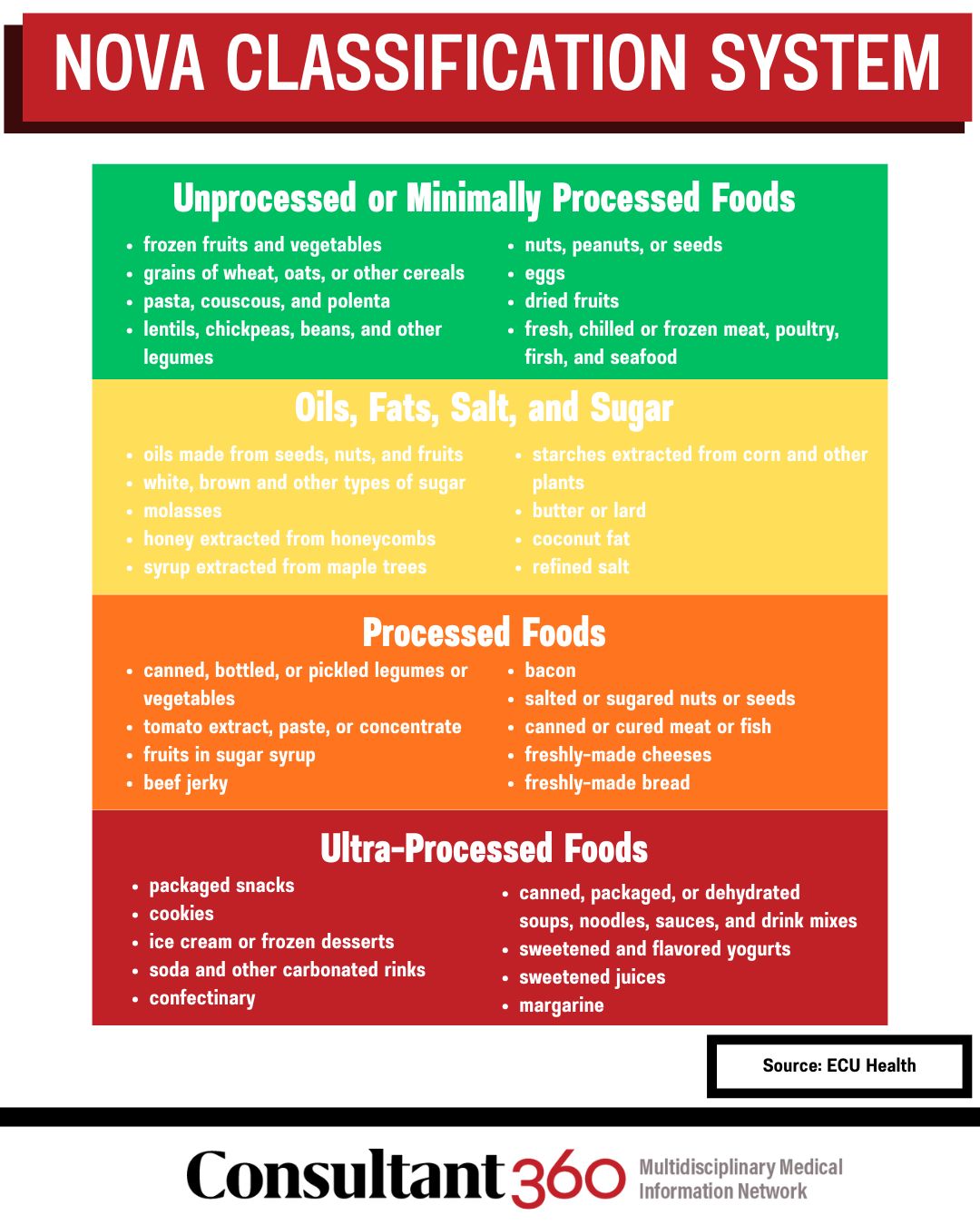
- The NOVA classification system uses a green-to-red framework to help clinicians and patients distinguish minimally processed foods from ultra-processed foods that are typically high in additives, sugar, salt, and fat.
- Most studies linking ultra-processed foods to cardiovascular risk are observational, meaning results should be interpreted alongside individual factors such as genetics, family history, and overall lifestyle.
- Beyond cardiovascular outcomes, higher intake of ultra-processed foods is also linked to increased inflammation and insulin resistance, contributing to broader cardiometabolic risk.
In part one of this four-part series, Lisa Jones, MA, RDN, LDN, FAND, and Grace A. Derocha, MBA, RD, CDCES, registered dietitian and a certified diabetes care and education specialist, discuss the latest research on ultra-processed foods in cardiovascular health.
Additional Resources:
- The NOVA Food Classification System. https://ecuphysicians.ecu.edu/wp-content/pv-uploads/sites/78/2021/07/NOVA-Classification-Reference-Sheet.pdf. Published 2018. Accessed Jan. 29, 2026.
Transcript:
Lisa Jones, MA, RDN, LDN, FAND: All right, well, hello and welcome to Nutrition411, the podcast, where we communicate the information that you need to know now about the science, psychology, and strategies behind the practice of dietetics.
Today's episode explores the connection between ultra -processed foods and cardiovascular risk, a rapidly evolving area of research with major implications for clinical practice. I'm so excited because today we are able to welcome back Grace DeRocha. She is a registered dietitian, certified diabetes care and education specialist, and health coach. She loves helping others learn how to live a healthier and happier lifestyle. Grace was born and raised in Michigan and attended Michigan State University (go green!), where she received two bachelor of science degrees in dietetics and psychology and completed her dietetic internship. She later earned her MBA with specializations in marketing and management from Wayne State University. Grace is proud to serve as one of the national spokespeople for the Academy of Nutrition and Dietetics, but she's also a wife, mom of two, dog mom, Spartan, an avid Detroit sports fan. She loves music, dancing, food, cooking, shopping, reading, and of course, smiling. That's why it's so fun to have her here for this podcast episode. But I want to dive right in, but first say welcome, Grace.
Grace A. Derocha, MBA, RD, CDCES: Hi, thank you so much for having me again, Lisa.
Jones: Yeah, we're so excited. So we're going to talk in this first segment about understanding the landscape. Grace, I kind of want to start with the big picture. So for you, what's new in research that links ultra-processed foods and cardiovascular risk?
Derocha: Yeah, so what we know, recent large analysis and deep dive research studies have shown that there really is that higher risk of cardiovascular disease and risk across diverse populations with a higher intake of ultra processed foods. That's like the short way to kind of say, yes, eating a lot of ultra-processed foods can increase your heart health risk, right?
There was a recent pooled review that took 41 cohort studies, so looking at over 8 million people, and it did find that each additional 100 grams a day of ultra-processed food was linked with a significantly higher risk of higher blood pressure, hypertension, and cardiovascular events like a heart attack or stroke. So it's really interesting to see that bigger picture in a variety of studies to see what actually these numbers kind of look like and what we're at risk for.
Jones: Yeah, well, it sounds like a lot. That's why it's so important to eat a heart-healthy diet, right? And I think a lot of times, too, these definitions that we have going out there, and you know this as a spokesperson, having the news media come at us every day with a different study, like, oh, eggs are good, eggs aren't good. Which one do we follow? Because definitions can get confusing. So how do you explain what counts as, let's say, ultra-processed in a way that makes sense to both clinicians and patients?
Derocha: Yeah, this is a great question. Because there's so much information out there. So how ultra processed foods are classified, there is something called the NOVA classification. So for clinicians, right, if we're looking at this kind of emphasizing processing the attributes that distinguish what is an ultra-processed food from minimally processed to, you know, overly or deeply processed. But I think really the best way to explain this in the NOVA classification system. They use kind of a stoplight color system, which everyone is kind of familiar with. Right? And with that, I think it can help people understand what is ultra-processed and what are the different stages of what that could look like.
So kind of briefly, but I think it's important to kind of talk about group one-ish. So green, if you will, like, green as in go if you're looking at the stoplight is minimally processed or unprocessed so things like frozen fruit or frozen veggies where like you pick the blueberries and then you just freeze them. Frozen fish, nuts are somewhat processed, so people say to me oh, I never thought about that, like nuts are processed. I'm like well anytime something's packaged or if they add salt, right some processing that's involved. So that's minimally processed food.
And then if we're going down the line, kind of group two, group three, it would be like light green or yellow. But group two is like more like your herbs or spices or even like oils and sugar and salt that are actually that food but still go through a process so that it can be served for us to use in cooking or seasoning or eating. And then as we're working our way down, when you get, you know, there's green, light green, yellow, orange, red. So red, if you're thinking about red, ultra-processed foods are those that are made mostly from things that are extracted from foods. So whether that be the starches or the oils or the fats of foods, but then also have some kind of synthesized something in laboratories, whether it's color, flavor, emulsifiers, additives, preservatives. And these foods are usually, with the way they're made to be more shelf-stable, are higher in salt and sugar and fats. And usually come in a package, right? They are packaged in some delightful way that your kids want to buy because there's some character on it or something like that. But yeah, that is kind of like the flow of what processed foods kind of go through when it goes from green to red. And then trying to make choices that align with trying to choose a little bit less of the red, right?
Jones: Yeah, I love that. I love anytime you can take like something that's kind of overwhelming to people and just say, you're all familiar with a stop sign. Like it's a green, yellow, red. We want to stop and not eat that. So I think that's really helpful to put that into those classifications and then kind of guide people because it's easier to remember, especially when you're already overwhelmed. You're a busy mom and you're in a, I'm just saying examples of many of our patients, that are in the supermarket and they don't want to be there for hours. Thinking like, is this processed? Should I not have that? Like it’s not like they have a dietician in the pocket or maybe that's the thing coming. Like they'll have a little avatar of the dietician popping up.
Derocha: Yeah, sitting on their shoulder. Yeah.
Jones: And then it's a little Grace and she's saying, don't eat that. Yeah. Or this is better choice.
Derocha: Yes. Yeah. Because I would never say don't eat that.
Jones: Well, this is you would say this is a better choice.
Derocha: Yeah. Yeah.
Jones: This is a healthier choice. All right. How about there's so many large studies. And there are some that have drawn connections between UPFs and heart disease. So what would you say about what these studies are finding that tell us and where should we be cautious in how we interpret them?
Derocha: Yeah, this is a great question. So kind of what I kind of started with in the beginning. What we do see more UPFs, ultra-processed foods, equals higher cardiovascular risk. Like that is a simple, clear statement, right? However, you know, when you kind of dive into studies, when you're looking at human beings where we're not in the lab and everything is not controlled. So a lot of the studies are observational, right? So there's other things that do come into play besides what they're eating and just their ultra-processed food intake so we want to make sure that we can prove causation in the process while we're kind of looking at this information and at the end of the day what I think is really important is besides the research and evidence-based science, is also when people tune into themselves and do the research and observations on themselves and know what their family history is, where their genetics lie, what their age and stage of life is telling them and where they need to be, so that then they can take some of that information with what we know with research and evidence-based science and tie it all together to make their best choices.
Jones: Yes. That's so important because everybody's different and we don't all have the same… There are some people, unfortunately, who have a family history of cardiovascular disease and they have to be, even if they're following everything in the diet and they still have high cholesterol because it's familial. So I think that's a really important point that you just made. So thank you for that. And just looking at beyond cardiovascular outcomes, are we seeing links between UPFs and other cardiometabolic markers? Of course, like we hear this all the time, inflammation or insulin resistance.
Derocha: Yeah, those are definitely words that people are kind of tuned into more now and paying attention to, right? So there is emerging research showing moving beyond just heart events, right, in cardiovascular health. There are different biological pathways and other risk markers, including inflammation. So we do know some of the research shows that higher UPFs, ultra-processed foods, the intake of that being higher and increased is associated with elevated circulating inflammatory biomarkers linked with cardiovascular disease, but that inflammation does play a big role in our health in general. So it's funny because people say inflammatory biomarker, like, what does that even mean? You know, like, what are these words? How do I find that out? And it is definitely something that can be tested. If you're seeing your cardiologist or seeing if your PCPs can order that for you, you can have tests done to kind of know where are mine right now, right? And with ultra-processed foods and inflammation, they do promote kind of that pro-inflammation dietary pattern that people that already have cardiometabolic disease or heart health issues just need to be extra aware and thinking about like, again, what can I control when it comes to my diet and nutrition that could be helpful instead of harmful?
And then being someone who does work with a lot of patients that have diabetes, thinking about insulin resistance and trying to work our way to not be resistant. UPFs. I keep saying, I keep defining it every time, like UPFs, ultra-processed foods, but UPFs may worsen insulin sensitivity. So meaning it is increasing our resistance to the own insulin, the hormone that we're making in our body, so that our body cannot proactively and efficiently use the insulin we're making. We have to be careful with that too, right? You know, in this bigger picture, when we're thinking about UPFs, finding that balance and cutting back on them to try to figure out ways to be heart healthier, watch the inflammation in our body, be more insulin sensitive so our body can use that insulin to help prevent type 2 diabetes or help control our blood sugars better. And thinking about how can we figure out these diet patterns for ourselves and our patients to help them in the long run?
Jones: Yeah, I love what you're saying, too, because it makes me really appreciate the power of what registered dietitians can do. And especially as a diabetes educator as well, you can kind of see working with patients over time, you can kind of see like, hey. Like if they come back to you, like, I don't know, like every three months or however often you're following them, you're following their care and kind of seeing, okay, you get the lab test done and maybe there's no improvement. You can quickly look at or quickly ask them, like, show me your food diary or show me how you've been tracking your food and identify some of these things that they may not see. Cause that goes back to what we were saying earlier with the processed foods. Like a lot of times patients and clients are consuming things that they don't realize contribute to things, and they can be making fine-tuned adjustments to kind of get their metabolic, their inflammation, their insulin-resistant improvement there.
Derocha: Yeah, and I think it's really important to note, too, like, all of this, you know, there's ties. We started, right, our conversation is mostly about heart health today and cardiovascular risk in ultra-processed foods, but what we consume and what we put in our body and how we nourish it is important for a variety of things, right? Blood sugar control, metabolism, inflammation, gut microbiome, which I didn't even touch on as well, but like that, making sure that we watch our consumption of UPFs to help that gut microbiome be at its best to digest the food properly, to absorb nutrients efficiently, to help with our hormone levels. It's all kind of important part of all these kind of puzzle pieces that work together for better health.
Jones: Yes, I love that. I love that the way that you said that. That's fantastic. Grace, thank you so much for sharing your insight, energy, and heart with us today. And thanks to our listeners for joining this episode of Nutrition411, the podcast.