


Osteoporosis Updates for Primary Care
Osteoporosis and subsequent fractures remain important public health problems in the United States, especially among postmenopausal women. Screening for osteoporosis is also underused for many reasons, including osteoporosis is a silent condition, screening guidelines are confusing, there is no reward for performing dual-energy X-ray absorptiometry (DEXA) screening, and there haven’t been many new osteoporosis therapies or studies.
This was the topic of discussion during this afternoon’s session at the Practical Updates in Primary Care 2020 virtual series. The speaker of this session was Jeffrey P. Levine, MD, MPH, who is professor and director of Women’s Health Programs in the Department of Family Medicine and Community Health at Rutgers Robert Wood Johnson Medical School in New Brunswick, New Jersey.
Identifying Patients for Osteoporosis and Osteopenia Therapy
Dr Levine urged everyone to evaluate all postmenopausal women aged 50 and older for osteoporosis risk and to consider whether ordering a DEXA scan is warranted, based on clinical fracture risk profile.
“Remember, you don’t only want to send patients for bone mineral density testing who are 65 or older, because then we’re going to miss many women who are younger, postmenopausal age, who have other medical conditions who are going to fracture long before they reach the age of 65,” Dr Levine said.
Secondary causes of osteoporosis include low body weight (body mass index of less than 20 kg/m2), use of systemic glucocorticoid therapy for 3 or more months, family history of osteoporotic fracture, early menopause, current smoking status, and excessive consumption of alcohol. He also suggested using the Fracture Risk Assessment Tool (FRAX®) to help identify patients at risk for fracture.
Pharmacologic therapy is strongly recommended for patients who have:
- A T-score of -2.5 or lower in the spine, femoral neck, total hip, or 1/3 radius
- Osteopenia or low bone mass and a history of fragility fracture of the hip or spine
- A T-score between -1.0 and -2.5 if the FRAX® 10-year probability of a major osteoporosis-related fracture is 20% or higher or the 10-year probability of hip fracture is more than 3% in the United States
He also mentioned which medications should be used to treat osteoporosis. Figure 1 lists all of the FDA-approved medications.
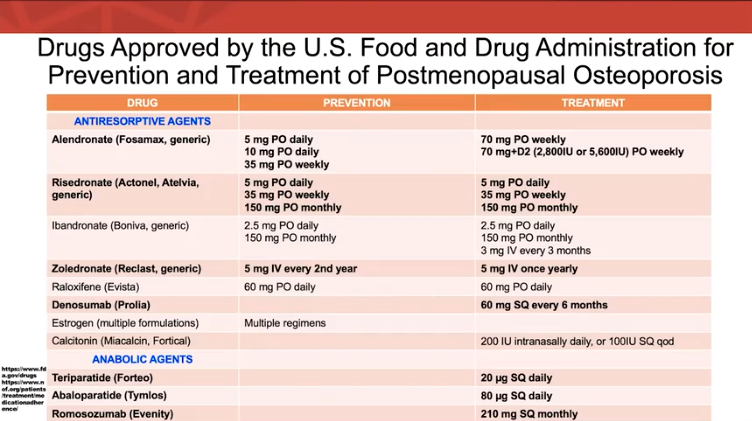
“Approved agents with efficacy to reduce hip, nonvertebral, and spine fractures, including alendronate, risedronate, zolendronate, and denosumab, are appropriate as initial therapy for most osteoporotic patients with high fracture risk,” Dr Levine said. “Abaloparatide, denosumab, romosozumab, teriparatide, and zoledronate should be considered for patients unable to use oral therapy and as initial therapy for patients at very high risk of fracture. Ibandronate or raloxifene may be appropriate initial therapy in some cases for patients requiring drugs with spine-specific efficacy.”
Monitoring Osteoporosis Treatment
Dr Levine recommended comparing baseline DEXA scans to follow-up scans for 1 to 2 years until the findings are stable. Then, you can space out DEXA scanning every 2 years and continue monitoring serial changes in lumbar spine, total hip, or femoral neck bone mineral density.
He also suggested that follow-up scans be done at the same facility and with the same DEXA machine to avoid any machine mishaps. He also suggested using bone turnover markers to assess progress.
Dr Levine defined successful treatment as “stable to increasing bone mineral density” with no evidence of new fractures or vertebral fracture progression. He said he typically uses bone turnover markers and bone formation markers to benchmark progress and to measure treatment success. He also said to consider alternative therapy if no markers are improving or if fractures continue.
Duration of Treatment
For abaloparatide and teriparatide, use can last up to 2 years, followed by a bisphosphonate or denosumab. Romosozumab can be taken up to 1 year, followed by a bisphosphonate or denosumab. Oral bisphosphonate can be taken up to 5 years if the fracture risk is no longer high or 6 to 10 years if fracture risk persists. Zolendronate can be taken up to 3 years in high-risk patients or until fracture risk is no longer high and up to 6 years in very high-risk patients.
“The ending of a bisphosphonate holiday should be based on individual patient circumstances such as an increased fracture risk, a decrease in BMD beyond the LSC of the DEXA machine, or an increase in bone turnover markers,” Dr Levine said.
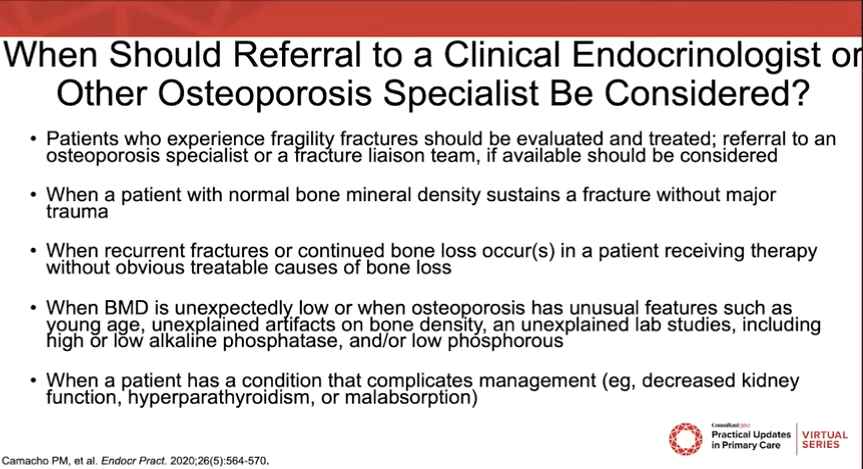
As a final thought, Dr Levine spoke about when patients should be referred to an osteoporosis specialist. Figure 2 lists the situations.
—Amanda Balbi
Reference:
Levine JP. Update on the management of postmenopausal osteoporosis. Talk presented at: Practical Updates in Primary Care Virtual Series; November 6-7, 2020; Virtual