


Medical Devices for Diabetes Management
While diabetes is a challenge for patients and primary care providers alike, technology has greatly improved patient outcomes and made the care of diabetes easier. In this Practical Updates in Primary Care 2021 session, Anne Peters, MD, discussed the medical devices for managing diabetes that are presently available and yet to come.
Dr Peters is a professor of medicine in the Keck School of Medicine at the University of Southern California and the director of the USC Clinical Diabetes Programs.
First Steps
“You really need to combine technology with education, with encouragement, with providing the patient with small steps as to how they should get better,” Dr Peters began. “So, I say give a patient a device, and then work with them to create small, actionable bits of advice to help them improve in terms of their glycemic control.”
Using a combination of A1c and continuous glucose monitoring (CGM) devices is the first step in obtaining an in-depth overview of your patient’s glycemic control, she said. Continuous glucose monitoring provides alarms and alerts to future dips and spikes in glucose levels, reducing glycemic variability in a way A1c does not.
Currently available options for CGM systems include Dexcom G6, FreeStyle Libre Basic and FreeStyle Libre 2, Guardian Connect, and the Eversense System. Both the Dexcom G6 and FreeStyle Libre models are currently approved for nonadjunctive use.
Advances in Technology
The ambulatory glucose profile is the next step in understanding what your patient needs, Dr Peters said. This provides a dashboard of 2 weeks of specific data on your patient’s glycemic management, including what percentage of time your patient is in the target range, their glucose highs, and, most important, their glucose lows.
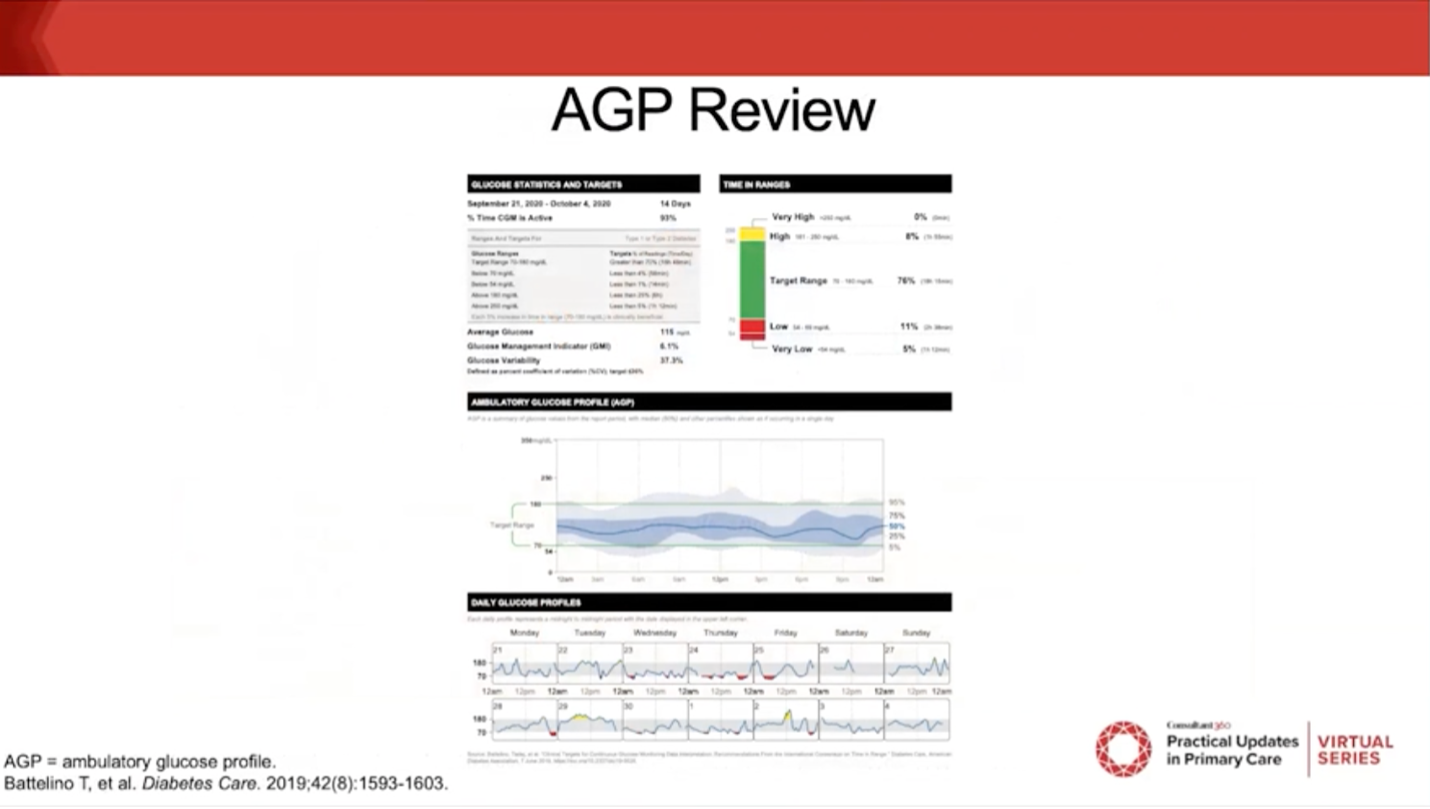
“It’s this glucose variability, the up and down, that’s really associated with a lot of the poorer outcomes, in particular episodes of hypoglycemia and severe hypoglycemia,” she said.
Next Dr Peters discussed smart pens, a first of its kind device that reports insulin dose data directly to the patient’s or provider’s smartphone. This technology removes the guesswork of how much insulin patients with multiple daily insulin injections are self-administering.
Finally, Dr Peters discussed how new technology has impacted the use of the classic insulin pump. Now that technology has enabled the pump and the sensor to work together in a hyper-closed-loop system, pumps are increasingly effective with potential to further advance diabetes care.
However, there are some important considerations when it comes to technology. These devices may result in site reactions on the skin and may need to be adjusted appropriately. Active patients may have issues keeping the device attached while exercising.
“Technology is really making a difference in our patients lives, it’s reducing A1Cs, it’s reducing episodes of hypoglycemia. I think it allows so many more options for patients and I think it empowers our patients to do better,” Dr Peters concluded.
—Leigh Precopio
Reference
Peters A. The present and future of medical devices for diabetes. Talk presented at: Practical Updates in Primary Care 2021 Virtual Series; May 13-15, 2021; virtual