


Identifying and Treating Pulmonary Arterial Hypertension
In his Practical Updates for Primary Care 2021 Virtual Series session, Michael Bloch, MD, discussed identifying and treating patients with pulmonary hypertension (PH), including what to do when a patient has evidence of elevated pulmonary pressure on an echocardiogram, and how to diagnose type 1 PH or pulmonary arterial hypertension (PAH).
Dr Bloch is an associate professor at the University of Nevada School of Medicine, the president of Blue Spruce Medical Consultants, PLLC, and the medical director of Renown Vascular Care and Renown Institute for Heart and Vascular Health.
Signs and Symptoms of PH
PH, which is elevated pressure in the pulmonary circulation, is very common, and it is a difficult diagnosis to make because the signs and symptoms of PH are nonspecific and overlap with other disorders.
“With these signs and symptoms, we need to be considering PH as a diagnostic possibility,” Dr Bloch said.
The symptoms include:
- Dyspnea
- Lethargy
- Fatigue
- Exertional chest pain
- Lower extremity swelling
- Abdominal pain and swelling
The signs include:
- Wide split S2
- Holosystolic murmur (tricuspid regulation)
- Elevated jugular venous pressure
- Hepatomegaly
- Lower extremity swelling
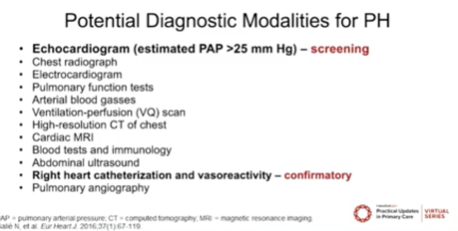
Dr Bloch said the key to making a PH diagnosis is to start by conducting an echocardiogram, which is an estimate of pulmonary pressure.
“An estimated pulmonary pressure on ECHO greater than 25 is consistent with PH and should at least cause some head scratching in your office as to why that patient may have elevated pulmonary pressures,” Dr Bloch said.

Once PH is identified, it is important to classify the type of PH is present.
“You are going to treat these patients very differently and have a very different prognosis based on the type of PH,” Dr Bloch said.
PH caused by left heart disease is considered the most common type of PH. PH caused by lung disease is the second most common type of PH. A patient should be treated for hypertension by treating the underlying disorder, like chronic obstructive pulmonary disease or obstructive sleep apnea.
“What we really don’t want to miss is the type 1, PAH,” said Dr Bloch. “It’s called PAH, or pulmonary arterial hypertension, and distinguished between the rest of these hypertension categories because it is directly caused by changes in the pulmonary artery itself, often due to autoimmune disease.”
Dr Bloch says the reason primary care providers need to pay attention to PAH is because it makes a big difference in the time to diagnosis of patients with PAH for their quality and length of life.
—Jessica Bard
Reference:
Bloch M. Identifying and treating PAH: impacting patient outcomes in the primary care setting. Talk presented at: Practical Updates in Primary Care 2021 Virtual Series; May 13-15, 2021; Virtual.