


How COVID-19 Is Affecting Mental Health in the United States
The COVID-19 pandemic and quarantine have had significant impacts on the general population’s mental health. This was the topic of discussion at this morning’s Practical Updates in Primary Care 2020 opening session.1
The session was presented by Holly Hendin, MD, PhD, who is a faculty physician in the Department of Psychiatry at Dignity Health St. Joseph's Hospital and Medical Center and an assistant professor of Clinical Medical Sciences at Creighton University School of Medicine in Phoenix, Arizona.
Social, Psychological, and Physical Impacts
During the session, Dr Hendin spoke about the social, psychological, and physical impacts of the COVID-19 pandemic and subsequent quarantine orders.
“In a pandemic, there are multiple things that are happening on a social level that are impacting mental health,” Dr Hendin said.
She said these factors include job loss and financial stress; childcare; uncertainty; disruptions to the routine of daily life; disruptions to usual coping mechanisms; loneliness and social distancing; worries about health, illness, and death; loss of loved ones; loss of expectations about the future; and grief.
“In this particular pandemic, as opposed to the flu pandemic in 1918, we are now in a digital world, which comes with benefits but also complications. We are social beings. We like to be around others. We gain a lot from being around others. And physical touch is important to humans,” Dr Hendin said.
So, when the quarantine and social distancing orders were issued in March 2020, usual daily life came to a halt. The effects of the quarantine include insomnia, irritability, frustration, fear and worries, changes in appetite, changes in substance use, changes in concentration, and changes in relationships with significant others, Dr Hendin said.
Some of the physical effects caused by other coronavirus outbreaks, including SARS and MERS, have included confusion, depressed mood, anxiety, impaired memory, and insomnia. In addition, depression, anxiety, and post-traumatic stress disorder are more likely to be diagnosed in patients who have had a coronavirus, such as SARS or MERS.
Current studies2 are investigating the physical effects of COVID-19 specifically.
Ameliorating the Impacts
Dr Hendin then spoke about how health care providers can further recognize mental health risks and potentially improve the well-being of themselves, their colleagues, and their patients.
“Young people [aged 18-24 years] are higher risk for suicidal ideation, as well as Hispanic or Black individuals, essential workers who are going through this pandemic, unpaid caregivers of adults, and people who have previously received treatment for depression, anxiety, or post-traumatic stress disorder,” Dr Hendin said.
Dr Hendin encouraged her audience to ask their patients about stressors and risks such as illness in family members or financial stress, substance use like caffeine intake or cannabis use, and daily activities such as sleep and exercise, as well as screen their patients for depression, suicidal ideation, and anxiety. Her slide on coping with COVID-19 for patients is shown in Figure 1.
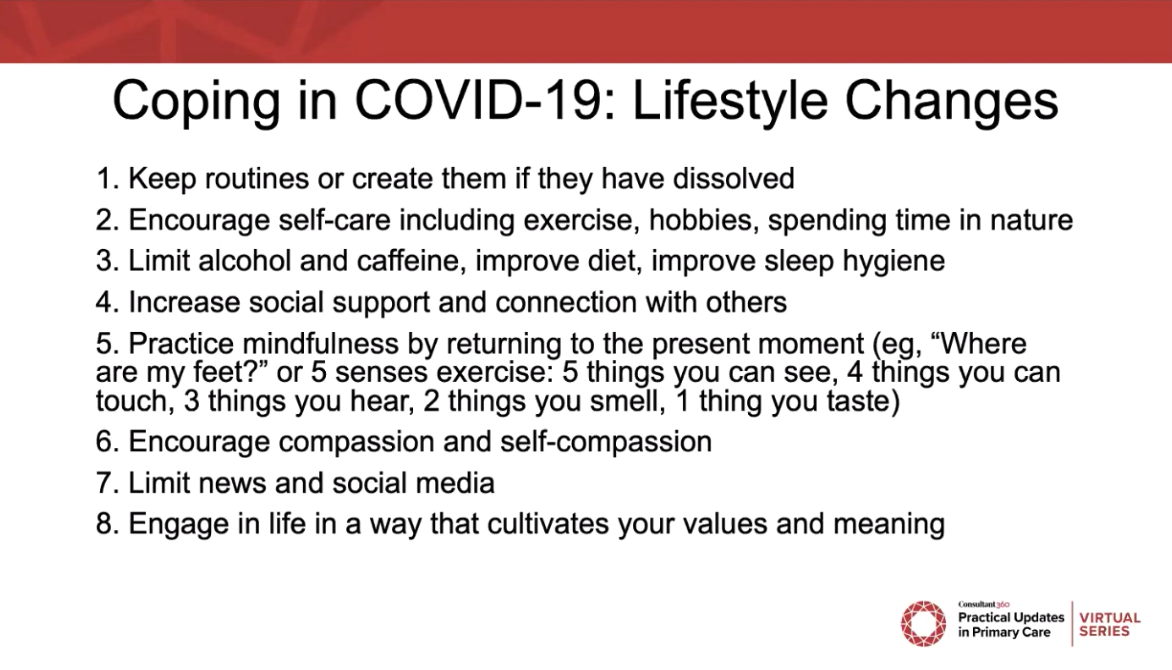
Figure 1.
“As health care providers, often we put our needs last. And maybe because of this, burnout is very common. Frontline providers, I would say, are even more at risk of burnout than non-frontline providers and are experiencing more depression, anxiety, and insomnia. And yet, less than 20% of all of us seek out professional support,” Dr Hendin said.
Her slide on coping with COVID-19 for health care providers is shown in Figure 2.
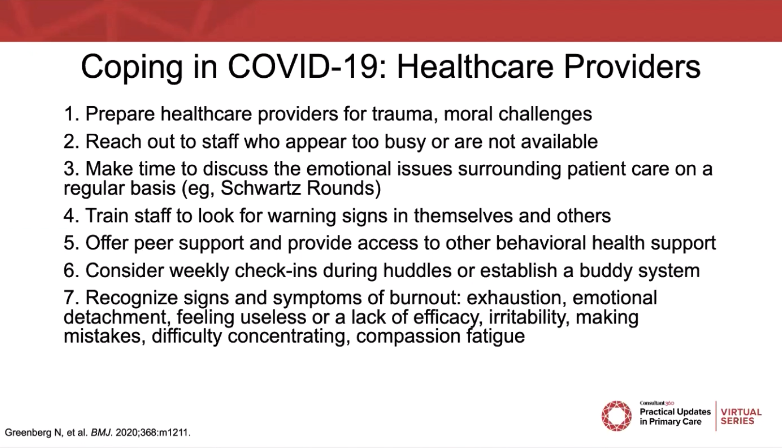
Figure 2.
“I’m hopeful that my talk today will encourage you, if you are suffering or know someone who is suffering, to encourage them to reach out for support,” Dr Hendin said. “… What I’m hoping is that you will be more attentive in yourself, your colleagues, your staff, your friends, and your family for these warning signs and really take care of yourself and others.”
--Amanda Balbi
References:
- Hendin H. COVID-19 & mental health. Talk presented at: Practical Updates in Primary Care 2020 Virtual Series; October 9-10, 2020; virtual.
- Rogers JP, Chesney E, Oliver D, et al. Psychiatric and neuropsychiatric presentations associated with severe coronavirus infections: a systematic review and meta-analysis with comparison to the COVID-19 pandemic. Lancet Psychiatr. 2020;7(7):611-627. https://www.thelancet.com/journals/lanpsy/article/PIIS2215-0366(20)30203-0/fulltext