


Persistent Long-Term Stroke Risk Found After Transient Ischemic Attack or Minor Stroke
Key Highlights
- Nearly 20% of patients with TIA or minor stroke experience a subsequent stroke within 10 years.
- Stroke risk remains elevated long after the initial event, with a 5.9% risk in the first year.
- Stroke incidence was higher in studies from North America and Asia compared with Europe.
- Long-term stroke prevention efforts remain insufficient and warrant enhancement.
Findings from a recent systematic review and meta-analysis published in JAMA, showed that patients who have had a transient ischemic attack (TIA) or minor stroke face a significant and enduring risk of subsequent stroke, with cumulative risks of 5.9% at 1 year, 12.8% at 5 years, and 19.8% at 10 years. These findings highlight the pressing need for more robust and sustained secondary prevention strategies in this high-risk population.
Despite advances in acute stroke care, the long-term prognosis following TIA or minor stroke remains incompletely understood. Clarifying these risks is critical to guiding clinical decisions on the duration and intensity of stroke prevention measures over time.
Researchers conducted a systematic review and meta-analysis of 38 prospective and retrospective cohort studies involving 171,068 patients. Data sources included MEDLINE, Embase, and Web of Science through June 26, 2024. Studies were eligible if they reported stroke incidence during at least 1 year of follow-up. Data extraction and quality assessment were performed by two independent reviewers. Incidence rates were calculated using unpublished aggregate-level data and pooled using random-effects meta-analysis.
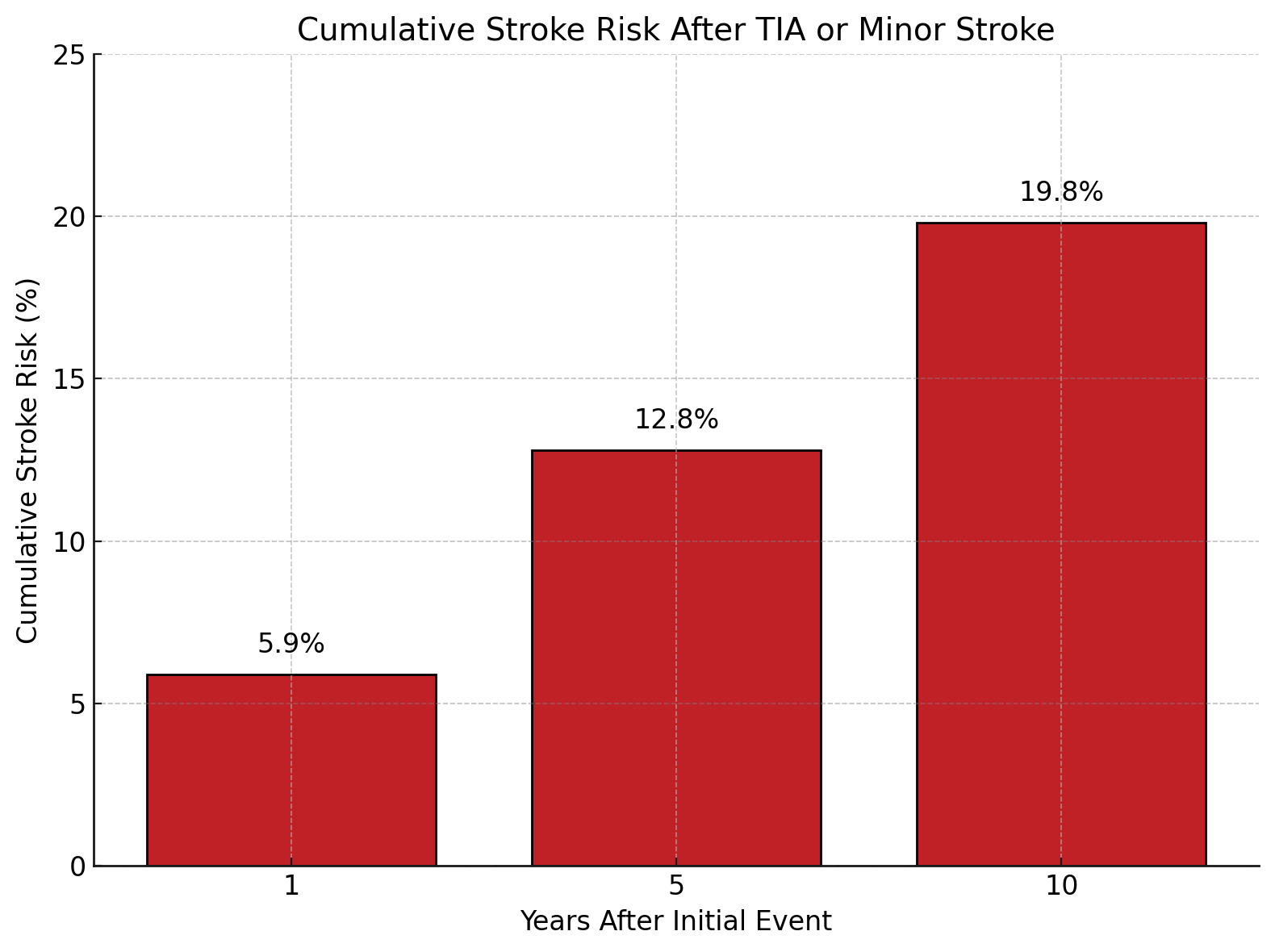
Stroke incidence was highest in the first year at 5.94 events per 100 person-years (95% CI, 5.18-6.76) and declined to 1.80 events annually during years 2-5 and 1.72 annually during years 6-10. Cumulative stroke incidence reached 12.5% at 5 years and 19.8% at 10 years. Subgroup analysis showed higher stroke rates in studies conducted in North America and Asia compared with Europe, in cohorts enrolled after 2007, and in those with active outcome ascertainment. Conversely, lower stroke rates were observed in studies that included only patients who had a TIA or only first-ever events.
“Patients who have had a TIA or minor stroke are at a persistently high risk of subsequent stroke,” the study authors concluded. “Findings from this study underscore the need for improving long-term stroke prevention measures in this patient group.”
References:
Writing Committee for the PERSIST Collaborators, Khan F, Yogendrakumar V, et al. Long-Term Risk of Stroke After Transient Ischemic Attack or Minor Stroke: A Systematic Review and Meta-Analysis. JAMA. 2025;333(17):1508-1519. doi:10.1001/jama.2025.2033