


Patient-Specific Opioid Taper Calculator Reduces Post-Arthroplasty Narcotic Prescriptions, Maintains Patient Pain Control
Key Highlights:
- The use of an individualized opioid taper calculator led to a 40% reduction in opioid prescriptions at discharge for patients who had either a total hip or knee arthroplasty.
- Pain scores and follow-up care metrics were not significantly different between groups.
- The calculator did not increase emergency department visits or pain-related clinic calls.
- The tool demonstrated effective implementation outside its original institution.
The use of a patient-specific opioid taper calculator significantly reduced postoperative opioid prescribing by 40% for patients following primary total hip arthroplasty (THA) or total knee arthroplasty (TKA) without negatively impacting pain control or increasing follow-up healthcare utilization.
Growing concern about postoperative complications linked to high opioid use has underscored the need for more responsible prescribing practices following total joint arthroplasty. Although various pain management protocols have emerged to reduce opioid dependence, a standardized approach to postoperative narcotic prescribing remains elusive. This study aimed to evaluate the effectiveness of a tailored opioid taper calculator as a potential solution.
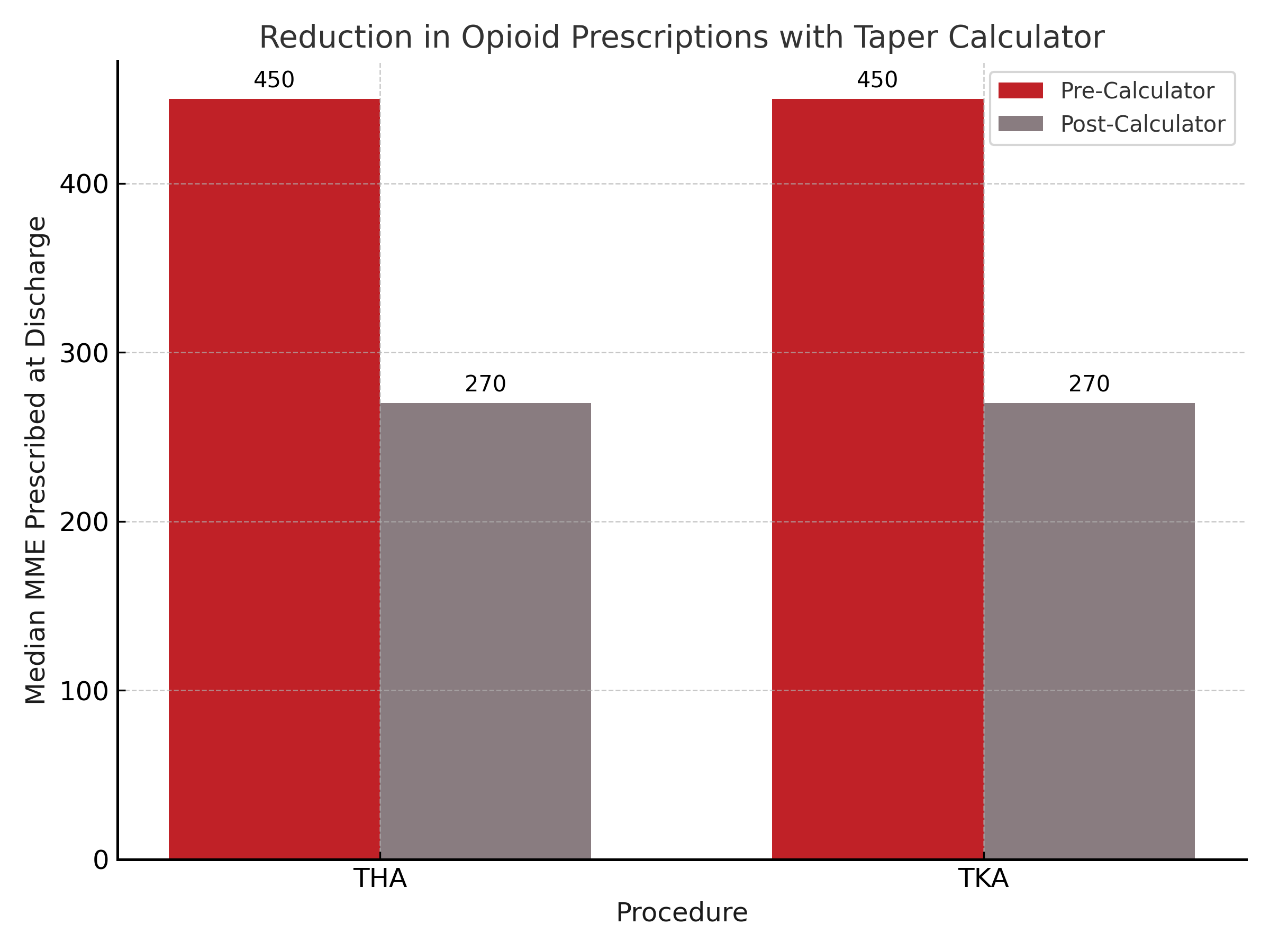
Researchers conducted a retrospective analysis of elective THA and TKA cases performed at a single academic institution. The study compared outcomes from patients treated before and after implementation of the opioid taper calculator. Data were drawn from 117 THA and 172 TKA cases in the precalculator group (2016–2018) and 105 THA and 139 TKA cases in the postcalculator group (2020–2022). The primary endpoint was the morphine milligram equivalent (MME) prescribed at discharge. Secondary outcomes included opioid refills, visual analog scale (VAS) pain scores, and pain-related emergency department visits or clinic calls. A significance threshold was set at P < .05.
Following calculator implementation, median discharge opioid prescriptions dropped from 450 MME to 270 MME in both THA and TKA groups (P < .0001). Importantly, this reduction was not accompanied by increased pain or follow-up care needs. VAS pain scores remained statistically similar between groups (THA: 3 vs 4, P = .47; TKA: 5 vs 6, P = .26). No significant differences were observed in emergency department visits (THA: 5.98% vs 0.95%, P = .069; TKA: 6.40% vs 11.5%, P = .155) or pain-related clinic calls (THA: 17.1% vs 24.8%, P = .186; TKA: 36.6% vs 37.4%, P = .906).
“Our findings support the use of a patient-specific opioid taper calculator to decrease the volume and variability of narcotics prescribed postoperatively for THA and TKA pain management,” the study authors concluded.
Reference:
Guzman RA, Ammons J, Westberg JR, Schmidt A. Implementation of a patient-specific opioid taper calculator for total hip and knee arthroplasty: a pre- and post-implementation study. J Arthroplasty. 2025;40(6):1478-1483. doi:10.1016/j.arth.2024.11.040