


Favorable Outcomes Achieved in Elderly Patients with Complex Terrible Triad Elbow Injuries after Single Lateral Surgical Approach
Key Highlights
- Mason Type III radial head and Regan-Morrey Type II coronoid fractures were most prevalent.
- Surgical management via a lateral approach led to favorable functional outcomes with minimal complications.
- Revision surgery was required in only 7% of patients, with no cases of postoperative elbow instability.
- Anterior capsule or coronoid reattachment in cases of instability contributed to elbow joint stability without significant stiffness.
This retrospective case series analyzed 29 elderly patients (mean age 72.3 years) with terrible triad elbow injuries (TTEI), revealing that these patients face a high risk of complex fracture patterns and associated injuries. Notably, 72% had Mason Type III radial head fractures and 69% had Regan-Morrey Type II coronoid fractures. Despite this complexity, surgical management via a single lateral approach achieved excellent functional outcomes with minimal complications or reoperation rates.
Terrible triad elbow injuries, which involve elbow dislocation accompanied by radial head and coronoid process fractures, are particularly challenging in older adults due to factors like decreased bone density, comorbidities, and greater susceptibility to falls. Prior literature has not extensively addressed how age influences fracture patterns, surgical outcomes, and complications in this setting, making this study particularly relevant given the aging population.
The study reviewed institutional data for 31 patients older than 65 years of age, ultimately including 29 after exclusions. Functional and radiographic outcomes were measured over an average follow-up of 49 months. Fractures were classified via the Mason and Regan-Morrey systems, supplemented by preoperative CT scans in 23 patients. Surgical treatment focused on restoring stability through prosthetic replacement or fixation of the radial head, reattachment of the lateral ligament complex, and selective repair or fixation of the coronoid and anterior capsule. All patients underwent surgery via a lateral Kocher approach, with no need for medial access.
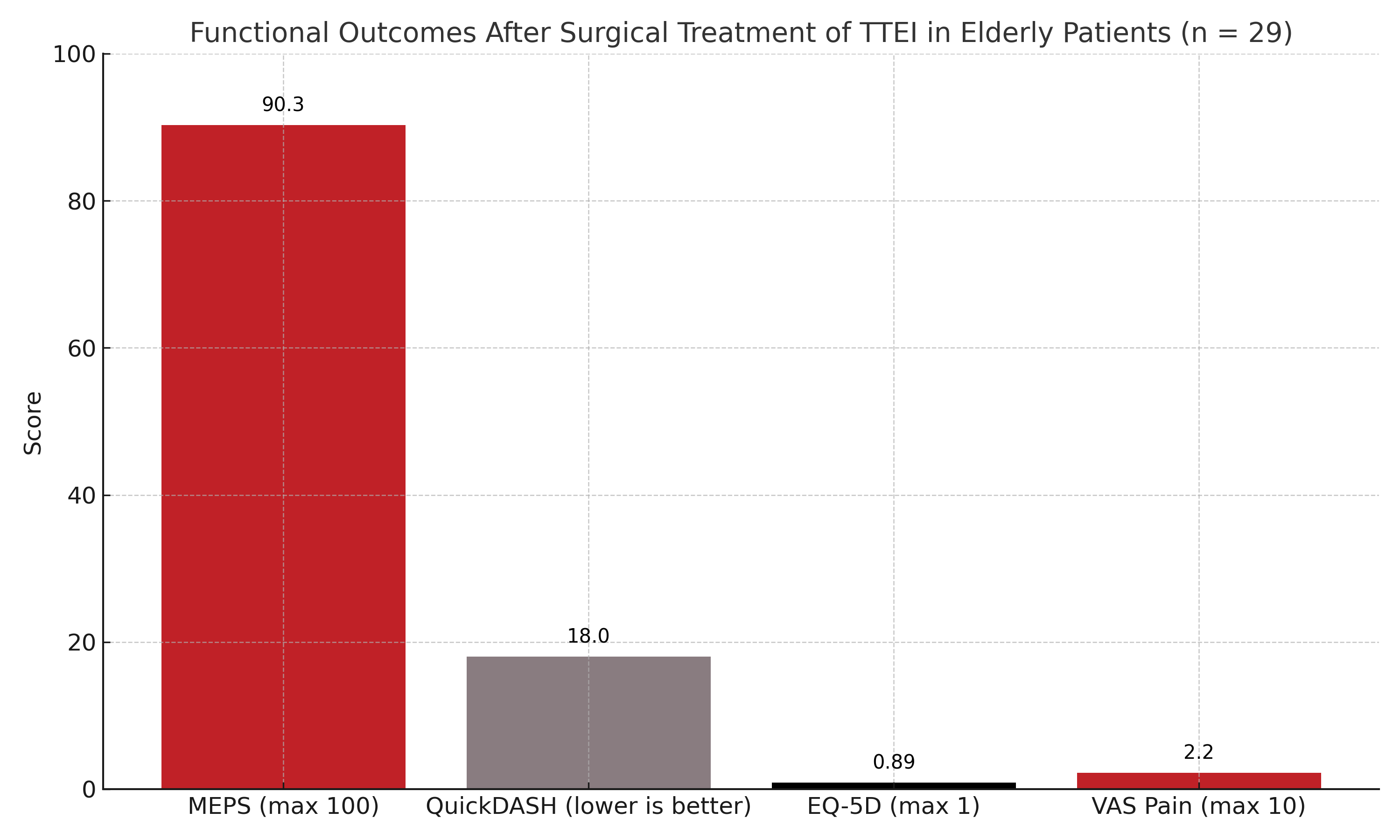
The study results demonstrated favorable functional scores: the average Mayo Elbow Performance Score was 90.3 (19 excellent, eight good, two fair results), QuickDASH was 18.4, EQ-5D was 0.89, and Visual Analog Scale for pain was 2.2. Elbow range of motion averaged a 105° flexion-extension arc. 65.5% of patients underwent coronoid or anterior capsule reattachment, which likely contributed to the absence of postoperative instability. Radiographic findings included 17% post-traumatic osteoarthritis and only one case (3.4%) of asymptomatic heterotopic ossification. Only two patients required revision surgeries (7%), both involving radial head arthroplasty removal.
The study limitations for this study include its retrospective design, relatively small sample size, lack of randomization, and incomplete CT imaging data. These constraints limit the generalizability of findings and the precision of fracture classification in some cases.
“Complications such as joint stiffness and heterotopic ossification are infrequent, while associated capitellum fractures are not rare and should be considered in the assessment as they can impact elbow stability,” the study authors concluded. “Despite these challenges, surgical management generally achieves favorable functional outcomes with low complication and reoperation rates.”
Reference:
Lopiz Y, Ciller G, Ponz-Lueza V, et al. Fracture patterns, outcomes, and complications of terrible triad injury in elderly patients. J Shoulder Elbow Surg. 2025;34(4):1098-1104. doi:10.1016/j.jse.2024.08.043