


Why isn't this rash responding to over the counter creams?

Case 1:
After 6 weeks of scratching a very itchy, worsening rash on his left leg, a 53-year-old man seeks medical evaluation. He has tried over-the-counter (OTC) topical remedies with no success. The patient is otherwise healthy and takes no medications.
What do you suspect?
A. Cellulitis.
B. Tinea corporis.
C. Contact dermatitis.
D. Urticaria.
E. Creeping eruption.
Case 1: Tinea corporis
A potassium hydroxide evaluation confirmed suspected tinea corporis, B. Cellulitis tends to be more painful than pruritic. The duration of both contact dermatitis and urticaria is days, not weeks. This patient did not have gyrate lesions without central erythema, which are typical of creeping eruption.
OTC agents may exacerbate dermatophyte infections. This patient contracted the dermatophyte from the household pet, a cat who rubbed up against his leg. Because the eruption was extensive, a systemic antifungal medication was prescribed; the infection resolved completely. The patient was advised to treat the cat as well by bathing the animal with OTC ketoconazole shampoo.
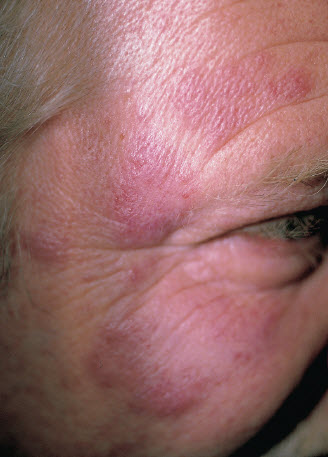
Case 2:
A 56-year-old man has had progressive, erythematous plaques across the forehead and temples for the past few weeks. He describes these areas as “a little itchy and a little tender.” The patient is otherwise healthy and takes no medications. Which of the following is the most likely cause?
A. Rosacea.
B. Seborrheic dermatitis.
C. Contact dermatitis.
D. Cutaneous lupus.
E. Photodermatitis.
Case 2: Cutaneous lupus A skin biopsy confirmed the diagnosis of cutaneous lupus, D; subsequent blood test results, including an antinuclear antibody assay, were normal. Rosacea commonly involves the central face but is in the differential. Seborrheic and contact dermatitides typically show more scaling and are not tender. Photodermatitis usually occurs following use of a systemic or a topical agent; this patient had no such history. The best management option for this patient is a sunscreen that blocks the UV-A spectrum, which aggravates cutaneous lupus.