


Robotic-Assisted Sleeve Gastrectomy Linked to Higher Post-Operative Pain Than Laparoscopic Approach
Key Highlights
- Robotic-assisted sleeve gastrectomy (RSG) was associated with higher post-operative pain scores than laparoscopic sleeve gastrectomy (LSG) within the first 24 hours.
- Intra-operative opioid use was significantly greater in RSG patients.
- Operative time was longer for RSG compared with LSG.
- Post-operative opioid consumption in the first 24 hours showed no statistically significant difference between RSG and LSG.
A study presented at the 2025 American Society for Metabolic and Bariatric Surgery Annual Meeting compared post-operative pain outcomes between robotic-assisted sleeve gastrectomy (RSG) and laparoscopic sleeve gastrectomy (LSG) in patients with obesity. The key finding was that patients undergoing RSG reported higher post-operative pain scores within the first 24 hours compared to those undergoing LSG. Additionally, intra-operative opioid use was greater in the RSG group, although post-operative opioid consumption did not differ significantly.
Post-operative pain is a critical factor influencing recovery trajectories and patient satisfaction following bariatric procedures. Sleeve gastrectomy, the most commonly performed weight loss surgery, is increasingly approached through both laparoscopic and robotic techniques. However, evidence regarding differences in post-operative pain between these approaches remains limited, necessitating further study.
Researchers conducted a retrospective analysis of all patients who underwent primary LSG or RSG at a single academic center in the United States between January 2020 and June 2023. Post-operative narcotic use was standardized to morphine equivalent dose (MED), and pain was assessed using the numeric rating scale (NRS-11) on post-operative day 1.
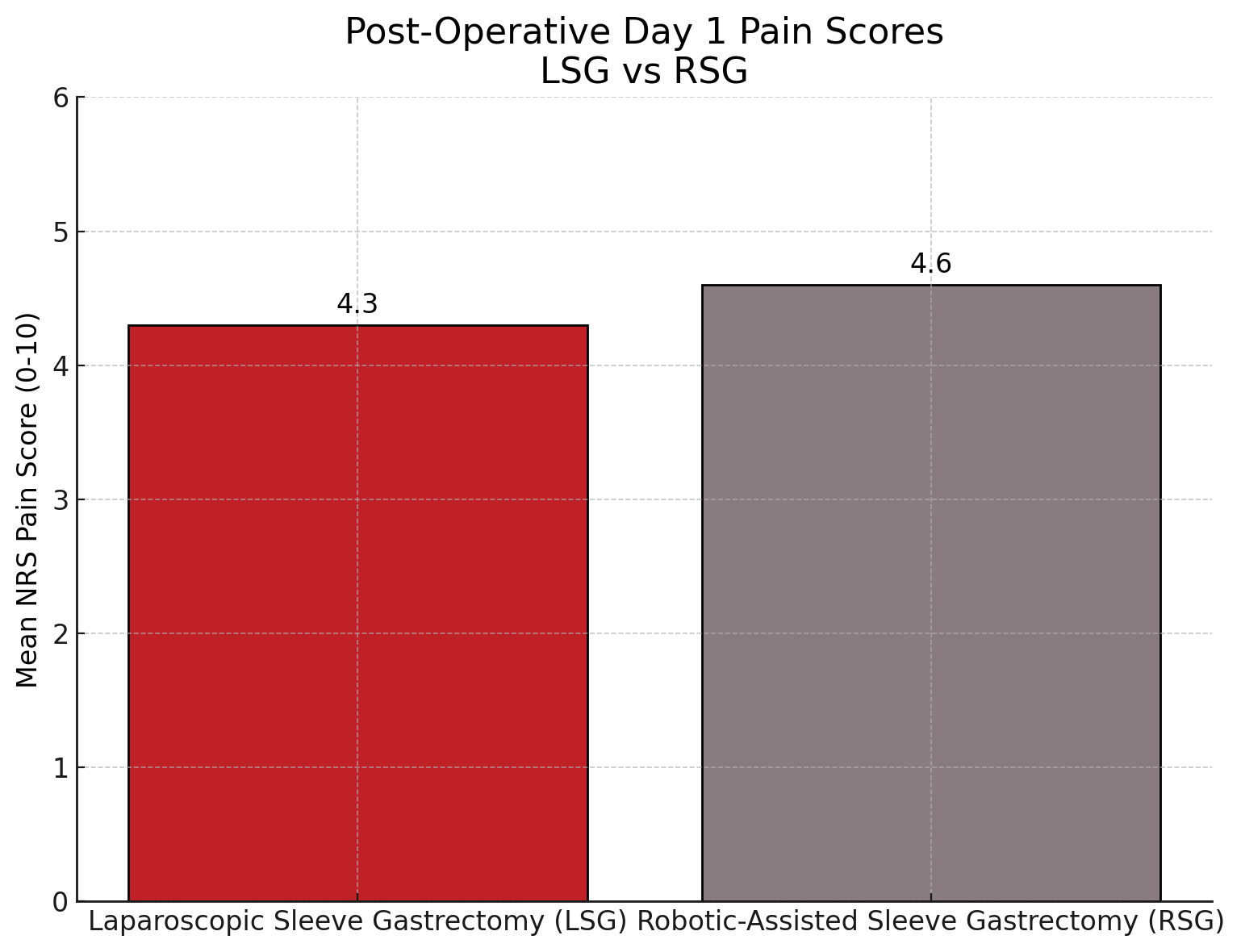
The study cohort comprised 651 patients (517 LSG, 134 RSG). Operative time was longer in the RSG group (mean 138.1 minutes, SD 127.4) compared with the LSG group (mean 96.9 minutes, SD 67.8; P < .001). Intra-operative opioid use was also higher in the RSG group (mean MED 11.5, SD 12.3) versus LSG (mean MED 5.19, SD 9.10; P < .001). Within the first 24 hours post-operatively, RSG patients reported higher NRS pain scores (mean 4.6, 95% CI 4.3-4.9) than LSG patients (mean 4.3, 95% CI 4.1-4.4; P = .025). The mean post-operative MED in the first 24 hours was 15.0 (SD 12.3) for RSG and 13.0 (SD 10.3) for LSG (P = .080).
“Findings of this study does not support the superiority of robotic-assisted procedure in terms of post-operative pain over laparoscopy,” the study authors wrote. “These findings from this observational study must be confirmed in randomized clinical trials.”
Reference:
Alavi MH, Foroumadi R, Wilson R, Feng X, Tu C, Navarrete S, Aminian A, Corcelles Codina R. Post-operative pain in patients with laparoscopic versus robotic-assisted sleeve gastrectomy. Presented at: ASMBS Annual Meeting; June 2025; Washington, DC. Accessed June 12, 2025. https://www.asmbsmeeting.com/event/2025/welcome.