


Hiatal Hernia Repair After RYGB Improves Refractory Reflux Symptoms
Key Highlights:
- Hiatal hernia repair (HHR) post-RYGB led to a significant reduction in reflux-related symptoms, with nearly half of patients achieving complete resolution.
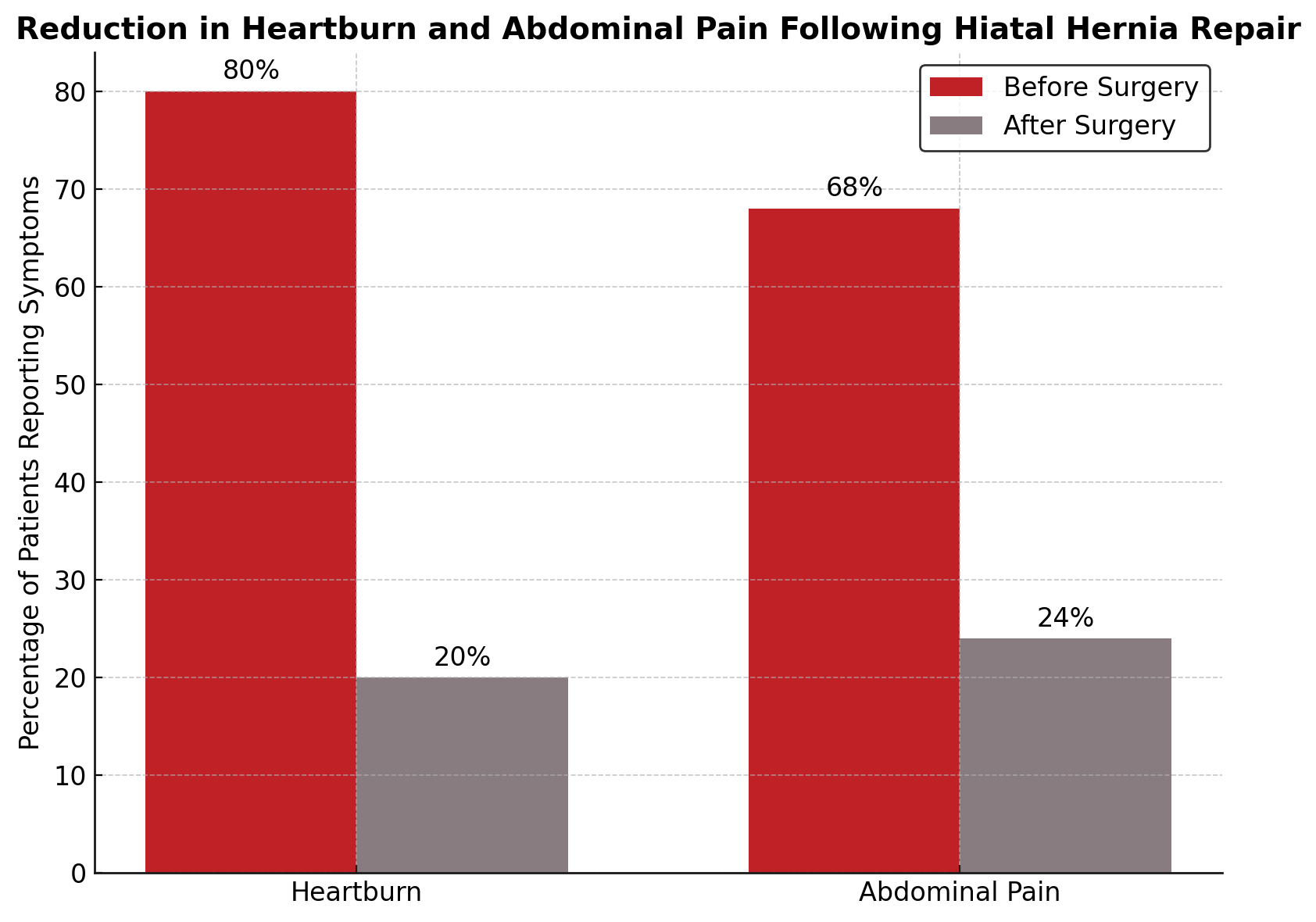
- Median symptom frequency dropped from 5 to 1, and heartburn and abdominal pain were the most persistent but still reduced.
- Study confirms HHR is an effective intervention for refractory symptoms after RYGB.
Patients who underwent surgical repair of a hiatal hernia following Roux-en-Y gastric bypass (RYGB) experienced a statistically significant reduction in reflux-related symptoms, according to findings presented at the 2025 American Society for Metabolic and Bariatric Surgery Annual Meeting Annual Meeting. Among the 50 patients studied, symptom frequency decreased from a median of 5 to 1, and nearly half reported complete symptom resolution following surgery. The most persistent postoperative symptoms—though significantly reduced—were heartburn and abdominal pain.
Gastric pouch migration into a hiatal hernia is a known complication that can occur years after RYGB. This condition is often associated with gastrointestinal symptoms that do not respond well to medical therapy, creating a need for effective surgical interventions. This study aimed to evaluate the efficacy of hiatal hernia repair (HHR) in alleviating these refractory symptoms among post-RYGB patients.
Researchers conducted a retrospective review of data from consecutive patients who underwent HHR following their initial RYGB between 2014 and 2024. Diagnosis of hiatal hernia was confirmed in all patients via upper gastrointestinal contrast studies, CT imaging, and/or esophagogastroduodenoscopy. Symptom outcomes, including nausea, vomiting, dysphagia, abdominal pain, regurgitation, and heartburn, were analyzed using McNemar and Wilcoxon rank tests. Results were presented as medians with interquartile ranges.
A total of 50 patients (47 women and 3 men), with a median age of 61 years [54, 66], underwent HHR at a median of 12 years [7, 18] after their RYGB. Follow-up data were available for 96% of participants (48 of 50). At a median of 8 months [2, 19] postoperatively, all six measured symptoms showed statistically significant reductions (P < .001 for all). The median number of symptoms decreased from 5 [3, 7] to 1 [0, 2]. Notably, 23 patients (46%) reported complete resolution of symptoms, while only 2 patients (4%) reported no improvement. Although the incidence of heartburn decreased from 80% to 20% and abdominal pain from 68% to 24% (P < .001), these symptoms remained the most common complaints after surgery.
“Repair of post-RYGB, de-novo hiatal hernia is an effective treatment and significantly improves symptoms of nausea, vomiting, dysphagia, abdominal pain, regurgitation, and heartburn,” the authors concluded.
Reference:
Brubaker L, Grist T, Ward M, et al. Repair of de-novo hiatal hernia post Roux-en-Y gastric bypass (RYGB) is associated with subjective improvement of reflux symptoms. Paper presented at: American Society for Metabolic and Bariatric Surgery 2025 Annual Meeting; June 15-19, 2025; Washington, DC. Accessed June 12, 2025. https://www.asmbsmeeting.com/event/2025/welcome