


Viewing Needle Prick Increases Pain in Vaccinations
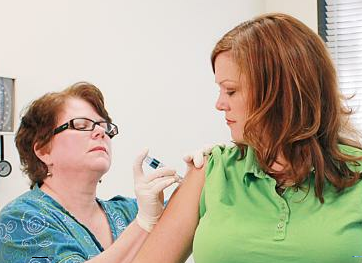 Viewing needle pricks can affect how you perceive the pain of an injection, researchers have found, adding credence to physicians’ age-old advice, “Don’t look and it won’t hurt”.
To further investigate this association, researchers showed study participants video of a hand being pricked by a needle, touched by a Q-tip, or remaining untouched. Participants were positioned so as to perceive the hand on screen as their own while receiving painful or non-painful electrical stimuli.
Intensity and unpleasantness of pain ratings, as well as pupil dilation were observed and recorded during the study. Manipulating the time between electrical stimuli and informing participants of the contingency measured the effects of expectation.
Pain was reported as more intense when participants viewed a needle pricking a hand than a hand with a Q-tip or a hand alone. Pupil dilation responses increased when viewing the needle pricking, further demonstrating that previous experience enhances the unpleasantness of pain.
Participants also reported increased pain intensity while viewing clips that were, according to researchers, more likely to be associated with pain, showing that expectation influenced intensity as well.
Researchers concluded, “Because viewing a needle prick leads to enhanced pain perception as well as to enhanced autonomic nervous system activity, we've provided empirical evidence in favor of the common advice not to look at the needle prick when receiving an injection."
-Michael Potts
Hofle M, Hauck M, Engel A, et al. Viewing a needle pricking a hand that you perceive as yours enhances unpleasantness of pain. PAIN. 2012;153(5):1074-1081. doi:10.1016/j.pain.2012.02.010 Accessed May 17, 2012.